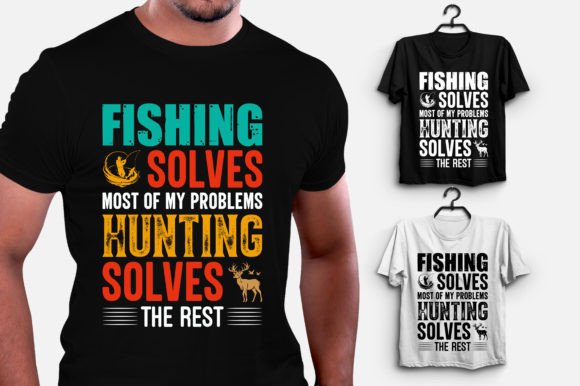
Fishing Solves Most of My Problems
As a designer who has spent years turning digital concepts into tangible stitched pieces, I approach every new embroidery file with a mix of excitement and skepticism. The market is flooded with generic text-based graphics that look great on a screen but fall apart under the needle. Recently, I evaluated the Fishing Solves Most of My Problems design to see if it holds up in a real-world production environment. This isn't just another piece of T-Shirt Designs; it is a statement piece that needs to survive the rigors of machine embroidery while maintaining its visual punch.
The First Stitch: Visual Personality and Mood
When I first opened the files for Fishing Solves Most of My Problems, the immediate impression was one of relatable humor mixed with outdoor grit. The layout feels balanced, suggesting a design that was built with stitching density in mind rather than just vector paths. It captures a specific mood—the quiet satisfaction of being by the water—that resonates deeply with hobbyists and crafters alike. Unlike many text-heavy designs that rely solely on font weight, this graphic seems to have a natural flow. It feels like it belongs on a well-worn apron or a sturdy canvas tote bag, not just a flimsy polyester shirt. The simplicity of the concept allows the thread colors to do the heavy lifting, creating a finished product that feels authentic rather than mass-produced.
Real-World Application: From Scrap Fabric to Boutique Shelf
I put this design through a simulated workflow to test its viability for various handmade products. Imagine preparing a custom embroidered sweatshirt for a client's birthday gift. The phrase "Fishing Solves Most of My Problems" works perfectly as a chest pocket accent or a centered back print. The spacing suggests it would hold up well on thick fleece without puckering, provided the correct stabilizer is used. However, my experience tells me that the true value of this machine embroidery design shines when applied to textured fabrics.
Consider an embroidered patch intended for a denim jacket. The clean lines of the text allow for a high-contrast satin stitch outline that defines the shape against rough denim. Similarly, for a tote bag design, the durability of the stitches is crucial. If you are selling these bags at a craft fair, customers will judge the quality by how the threads lay against the fabric. This design offers enough negative space to prevent overcrowding, ensuring the message remains legible even after multiple washes. For baby embroidery, such as a onesie or a small bib, the softness of the surrounding area (if any) combined with the clear lettering makes it a safe choice for delicate skin, assuming fine-gauge needles are used.
Navigating Technical Challenges
Not every project is a perfect fit, and honest review requires acknowledging where Fishing Solves Most of My Problems might struggle. One critical factor is the hoop size. While the design likely scales well, attempting to stitch this on a very small hoop, such as those used for hat panels or tiny baby accessories, could compromise the integrity of the letters. Tight corners and sharp angles often require careful trimming, which can be difficult if the design includes intricate decorative accents that aren't clearly defined in the source files.
Fabric texture plays a massive role in the final outcome. On stretchy knit fabrics, the tension of the fill stitch can cause the garment to pucker if not stabilized correctly. Dark fabrics present another challenge; unless the design includes a contrasting white underlay or the thread selection is bold enough, the text might get lost. I always advise testing on scrap fabric first to check thread color contrast. If the original digital embroidery file does not specify the recommended thread colors, you must experiment to ensure the text pops against your chosen material. Furthermore, curved surfaces like caps require a design that accounts for distortion. A straight-line text layout might need digitizing adjustments to curve naturally around the cap's crown.
Impact on Product Value and Brand Consistency
For Etsy sellers and small shop owners, the quality of the embroidery directly impacts customer trust. A sloppy stitch job can ruin a brand's reputation, while a crisp, professional finish elevates the perceived value of the item. Fishing Solves Most of My Problems has the potential to enhance commercial embroidery projects because it strikes a balance between trendy and timeless. It appeals to a broad demographic, making it versatile for holiday gifts, wedding favors, or corporate swag.
The design's clarity contributes to a professional presentation. When a buyer sees a clean, well-executed stitch pattern on a kitchen towel or a pillow cover, they perceive the entire item as higher quality. This attention to detail fosters recognition and encourages repeat business. In a crowded marketplace, having design assets that translate seamlessly from screen to fabric is a competitive advantage. It ensures that the finished product matches the printable mockup shown in your listing, reducing returns and increasing buyer satisfaction.
Practical Designer Notes for Success
To get the most out of this design, there are several technical steps you should follow before running a full production batch. First, verify the stitch density. High-density areas can lead to thread breaks or fabric damage if the machine speed is too fast. Review the running stitch and satin stitch transitions to ensure smooth edges. Always confirm whether the license terms allow for personalized gift creation or commercial resale of the finished items. If you are unsure about the file formats or compatibility with your specific machine, consult the documentation included with the download.
Testing is non-negotiable. Run a sample on the exact fabric you intend to use. Check the thread colors under different lighting conditions to ensure visibility. If you are using a digital embroidery file for a large order, create a few variations to see how the design reacts to different stabilizers. For apparel decorators, remember that the right stabilizer is just as important as the design itself. A floating applique technique might be necessary if the design includes separate elements that need layering.
Final Thoughts on a Versatile Asset
In conclusion, Fishing Solves Most of My Problems stands out as a practical and engaging addition to any collection of graphics for textile artists. It avoids the pitfalls of over-complication and focuses on delivering a clear, humorous message that connects with people. Whether you are creating a unique embroidered patch for a client or producing a line of sweatshirt embroidery for a boutique, this design offers a solid foundation. By paying attention to the technical nuances of stitching and fabric selection, you can transform this simple text concept into a premium handmade product that customers will cherish. It is a reminder that sometimes, the best designs are the ones that speak the truth, one stitch at a time.